
Washington County Supervision Types
Ohio uses several forms of supervision after custody. Parole applies to eligible indefinite or life sentences when the Ohio Parole Board authorizes release. Post-release control follows certain prison terms and is managed by the Ohio Adult Parole Authority, or APA. Washington County Adult Probation instead handles court-ordered Community Control, Judicial Release, and Intervention in Lieu of Conviction for Common Pleas cases. Municipal probation may be managed through the municipal court. The key question is not simply whether someone is “on probation.” It is which judgment or release decision created the supervision.
A Washington County jail release does not by itself establish parole or probation. Bond may return a person to the community while the case remains pending. Time served can end confinement, yet a sentencing entry may add community control. A transfer to an Ohio Department of Rehabilitation and Correction institution is continued custody, not community supervision. Later, an ODRC status of APA Supervision or Judicial Release can show that the person left state prison under a defined form of oversight.
| Status | How it begins | Primary verification source |
|---|---|---|
| Parole | Ohio Parole Board action on an eligible sentence | ODRC Offender Search and parole detail |
| Post-release control | Supervision following a prison term when imposed | ODRC status, supervision dates, and APA office |
| Judicial Release | Court-ordered prison release to community supervision | Common Pleas order and local Adult Probation |
| Community Control | Local court sentence served in the community | Sentencing docket and Washington County Adult Probation |
- Discharge
- The formal end of a custody or supervision term.
- Absconder
- A supervised person alleged to have stopped reporting or left supervision without permission.
- Detainer
- A notice or request from another authority that may affect custody or release.
- Revocation
- An official process that may cancel community supervision after a violation finding.
Check Washington County Supervision
The ODRC Offender Search is the main public route for state parole, post-release control, Judicial Release, and Violator at Large records. Begin with broad criteria. A DRC number is best when known. Otherwise, use the last name or first and last names, then compare date of birth, committing county, docket, offense, and status. County of Commitment means the sentencing county. It is not the person's present address. Residential County works only with APA or violator records and may reflect an older reported address.
For a local court sentence, read the Washington County Common Pleas docket and contact Adult Probation. ODRC does not list every person on county Community Control. Marietta Municipal Court matters may use a separate probation route. Its online court data may also post at least a day late. The judgment entry is the sound starting point because it identifies the sentence, judicial release, probation term, or later revocation.
- Identify whether the last custody was the county jail or an ODRC prison.
- Search ODRC with status set to All before narrowing to APA Supervision or Judicial Release.
- Open the matching detail and read release information, supervision dates, period, and listed APA office.
- For Community Control or Intervention in Lieu, check the sentencing docket and Washington County Adult Probation.
- Call the listed office when a current instruction or a conflict between records must be resolved.
The successful ODRC released and supervised result capture shows how identity, sentence, status, and release fields appear together.
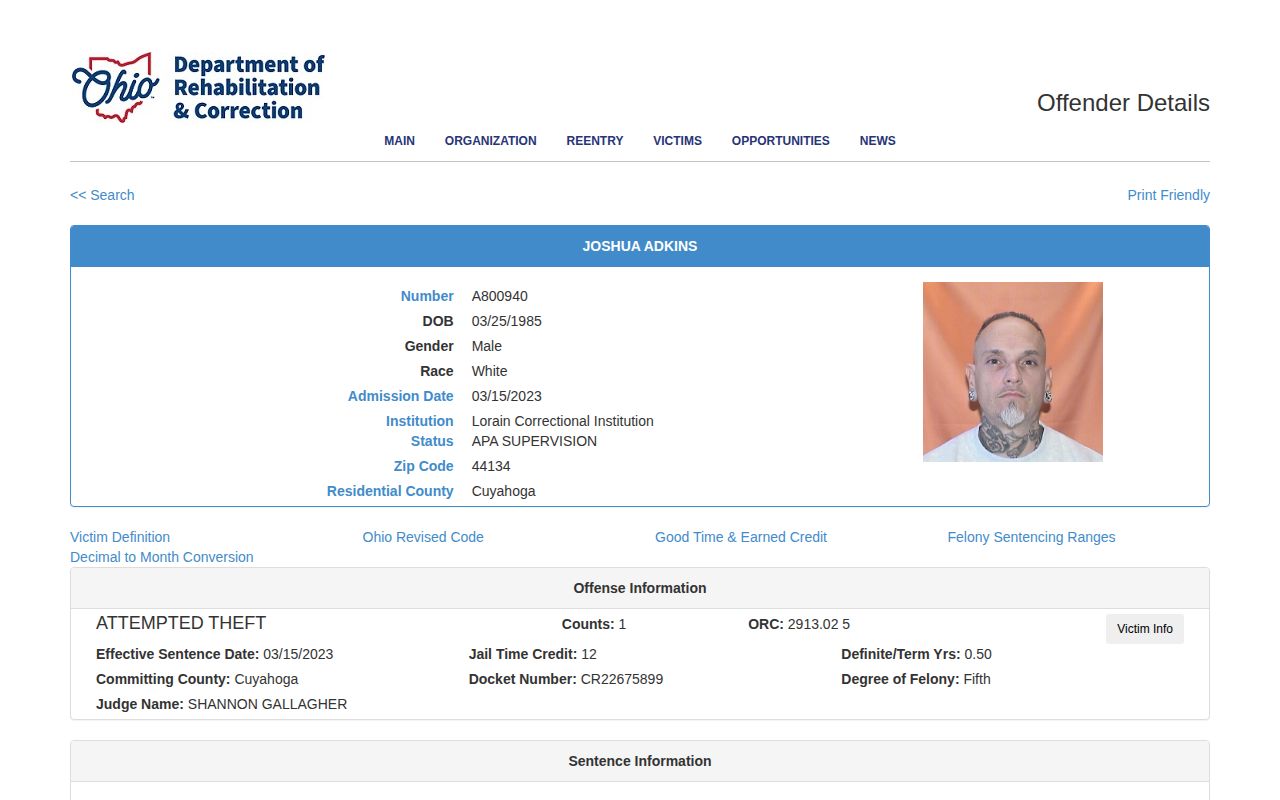
The screen layout helps separate a state release status from the earlier Washington County jail booking. Check the displayed record against the court case before drawing a conclusion.
Status All is a sound first pass because it avoids guessing which label ODRC will apply. APA Supervision identifies state oversight after prison. Judicial Release points to a sentencing-court release and local supervision. Released can mean the ODRC custody or supervision relationship ended, but the release-detail fields should still be checked. When dates conflict, the latest court entry and the responsible agency's record carry more weight than a cached search result.
Note: An ODRC released record may describe a later state-prison event, not the day the person left the Washington County Jail.
Washington County Supervision Offices
Washington County has a clear local and state division. The Washington County Adult Probation Department supervises Community Control, Judicial Release, and Intervention in Lieu of Conviction. The office is part of the Common Pleas court system. Ohio APA handles state parole and post-release control. A person can be supervised after release without ever having been on parole, so matching the case to the right office prevents delays and wrong status labels.
The county directory also lists the Adult Parole Authority through the county complex telephone system. Still, an ODRC individual detail is the better first check for the assigned APA office. State assignments can depend on the record and the last reported residence. Local Adult Probation should be used when the Common Pleas judgment created the supervision. The department directory identifies current staff and extensions, which can change.
Washington County Adult Probation223 Putnam Street
Marietta, OH 45750
740-373-6623
Verify the current department extension through the official directory.
Note: Confirm the sentencing court before calling, since ODRC APA, Common Pleas probation, and municipal probation maintain different records.
Washington County Supervision Warrants
Two warrant layers matter after release. The sheriff's Washington County active-warrant list changes daily and is current only when created. A bench warrant can follow a missed court event or an alleged violation. That list does not show present jail custody, nor does it supply a release date. The sheriff directs users to verify through dispatch at 740-376-7070 ext. 0.
The state ODRC Parole Violators at Large list is narrower. It concerns people under APA supervision who are declared at large. Public fields can include a photograph, name, DRC number, birth date, declared-at-large date, and offenses. ODRC warns against trying to apprehend anyone and requires official warrant checks through law-enforcement systems. A public entry is an alert, not a live location or proof of current custody.
The official ODRC violator listing illustrates the separate state absconder channel.
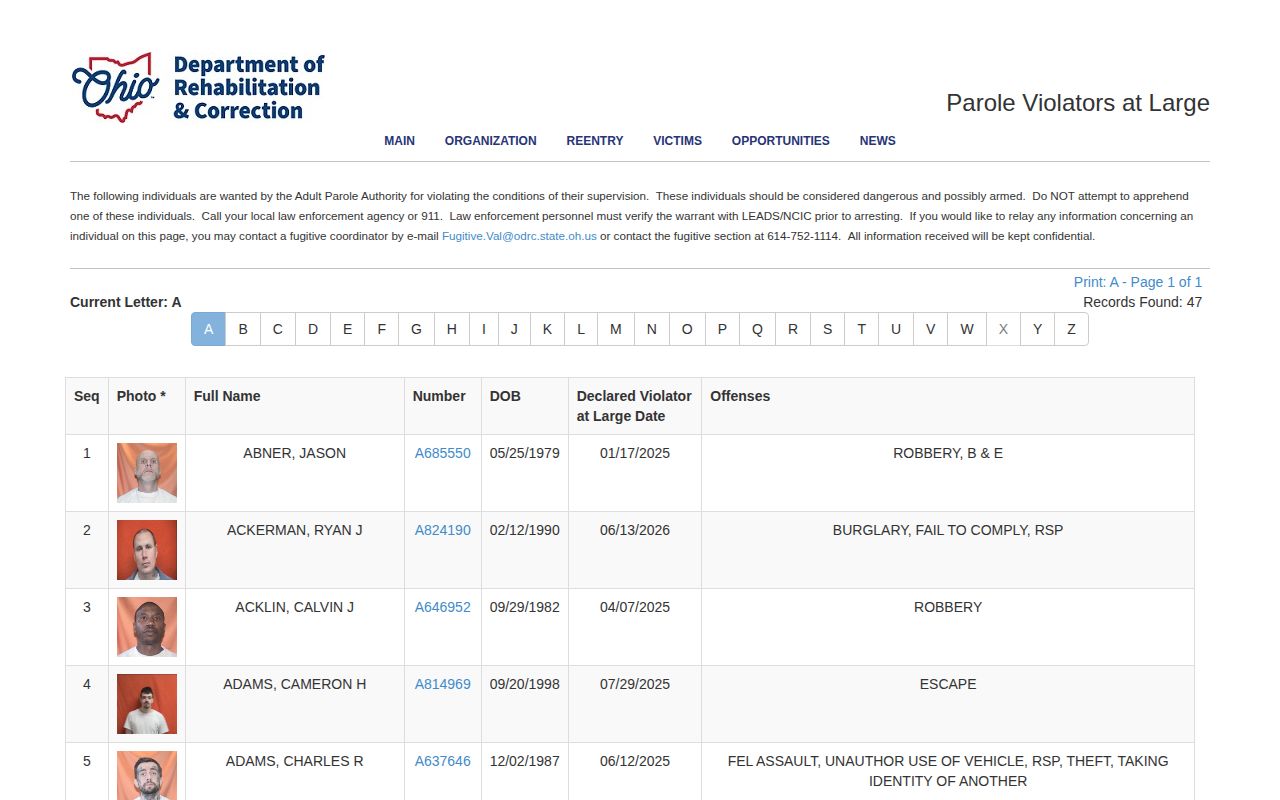
The warning on that official screen is central: confirm an active warrant with law enforcement, and never treat the list as an instruction to approach a person.
Washington County Supervision Changes
Conditions vary by judgment and supervision type. Common duties may involve reporting, following court orders, attending approved programs, and complying with location or contact rules. The exact terms belong in the judgment, release paperwork, and agency instructions. Public records may not reveal every condition because Ohio law protects parts of probation, parole, and post-release-control files.
An alleged violation does not automatically prove revocation. The supervising agency may investigate, a court or Board process may follow, and the record may later show a warrant, return to custody, continued supervision, or discharge. A transfer alert also differs from a revocation. When status matters, record the date of the lookup and ask the responsible office to resolve stale or conflicting entries.
Washington County Release Continuity
The sheriff's IGNITE program creates a documented bridge across release. Washington County says the online educational work can continue after a participant returns to the community. That makes the program more than an in-custody class. It can preserve access to course work during the shift from jail custody to local supervision or unsupervised community life.
Participation does not identify a person's legal status. It also does not promise a result. The court order, sheriff release record, and supervising agency still control. For someone already enrolled, the official IGNITE page is the right place to confirm how access continues. Questions about probation terms belong with Adult Probation, while APA terms belong with the assigned state office.
Washington County Supervision Records
Ohio Revised Code 149.43 supports access to public records but also contains criminal-justice exclusions. Some probation, parole, post-release-control, investigatory, medical, sealed, and other protected material may be withheld. ODRC records have added limits under ORC 5120.21. Public Offender Search can disclose useful identity, conviction, location, and supervision status fields without opening the full APA case file.
Use a focused request when a public detail is not enough. Ask for an existing order, docket entry, official minutes, or releasable discharge field. Do not ask staff to create an explanation. A Common Pleas journal entry may establish Judicial Release or Community Control, while an ODRC detail may establish APA Supervision. For the broader county release path and sheriff record, use the Washington County released-inmate search.
Washington County Supervision Discharge
Supervision ends through a formal agency or court action, not merely because a projected end date passes. An ODRC detail may show a supervision start, end, early termination, or release detail. A county case may show termination of Community Control or closure after the required term. Parole and post-release control have state records; local probation has court and department records.
Read the latest entry and confirm it with the office that issued it. A past end date can coexist with a newer case, warrant, or another form of supervision. Likewise, discharge from supervision does not rewrite the prior jail or prison release record. It marks the end of that specific oversight term.
For a state case, note the DRC number, displayed supervision period, APA office, and retrieval date before asking for clarification. For a local case, use the case number and the most recent journal entry. Those identifiers help staff locate an existing record and reduce confusion between people with similar names. If a public portal still shows an old status, ask which agency record controls and when the public display is expected to update.