
Washington County Projected Release
A projected date is a calculation or review marker. It is not proof that the person walked out. ODRC labels its public field Expected Release Date/Parole Eligibility Date. The same label can describe a projected release date or a date when parole consideration becomes possible. PRD means Projected Release Date. POA means Parole On or After. Neither term should be shortened to “released” before the status and release detail confirm the event.
An actual release is a completed custody event shown by the responsible agency. For a state prisoner, look for a Released, APA Supervision, or Judicial Release status plus matching parole or release detail. For a local jail stay, use a sheriff release record with the release time and authority. A court order may authorize release, but it does not always prove the exact physical exit time. Transfers to ODRC, another jail, federal custody, or ICE end the local roster entry without ending custody.
Search Washington County Release Dates
Start with the last known custodian. The ODRC Offender Search serves people who entered Ohio state-prison or APA systems. It can be searched by DRC number, name, County of Commitment, status, and other criteria. A person who served only a local misdemeanor term may never appear there. For the Washington County Jail, use the official released-person checkbox, then the court and sheriff records routes.
Use the smallest reliable set of search facts. A DRC number is strongest. With a name search, compare birth date, docket, committing county, offense, admission, and institution. County of Commitment means the sentencing county and can behave differently in a multi-county sentence. It does not show where the person now lives. Always save the date when the record was checked, because projected fields and statuses can update.
- Decide whether the person is pretrial, serving a county sentence, or serving an ODRC sentence.
- For state custody, search ODRC and open the exact matching detail.
- Read the full Expected Release Date/Parole Eligibility Date label, sentence fields, status, and release detail.
- For county custody, obtain the judgment entry and ask Corrections or sheriff records for the computed local date.
- Check for detainers, later orders, or transfers, then confirm again near the expected event.
The ODRC offender-detail example captured for this project shows the status, sentence, and release-date areas that must be read together.
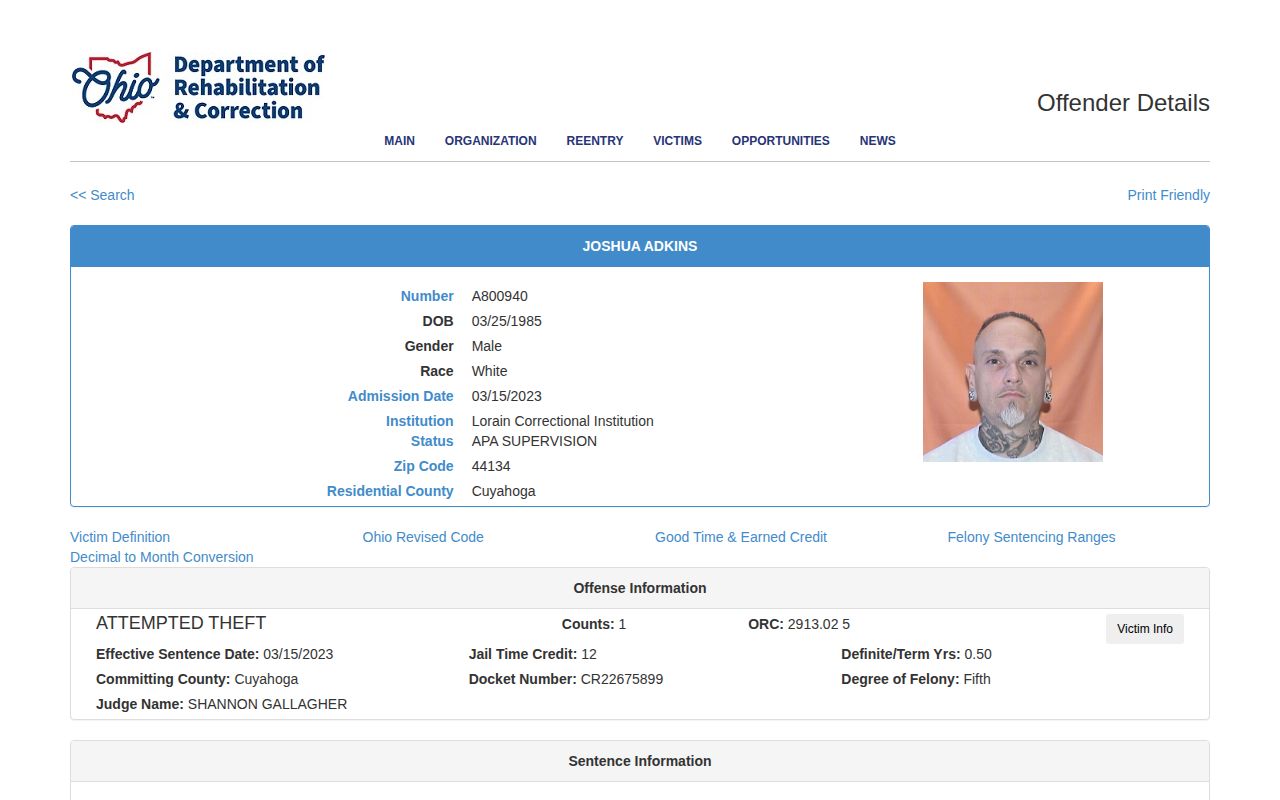
The layout demonstrates why one date should not be separated from the sentence and status around it. The label's parole-eligibility wording can change its meaning.
An ODRC detail may also show admission date, institution, sentence length and type, effective sentence date, jail-time credit, aggregate sentence, next hearing, and latest review result. Each can change how the expected field is read. A person listed as Incarcerated remains in prison even if temporarily away for court. A person under APA Supervision has left prison but remains under state oversight. Identity and status must be settled before the date is interpreted.
Note: ODRC covers state commitments and supervision, not a stand-alone Washington County jail term that never entered state custody.
Washington County Jail Release Dates
A pretrial detainee generally has no sentence-based release date. Release can turn on posting bond, recognizance, dismissal, a new court order, or resolution of another hold. The current roster only answers whether someone is listed at the time of retrieval. When the name disappears, use the official Include Released Inmates? option and check the court docket. Roster absence alone cannot distinguish community release from transfer or another custody change.
A sentenced local inmate requires the actual judgment, jail-time credit, and sheriff computation. Jail-time credit is time the sentencing court credits toward the term for qualifying confinement tied to the offense. The release record should then confirm the time and authority used when custody ended. For exact historical detail, request the booking and release record through the Washington County sheriff's public-record route or call the records number listed there.
| Custody situation | Best date source | What the date means |
|---|---|---|
| Pretrial county detainee | Court bond/order plus sheriff status | No fixed sentence date; release depends on legal action and holds |
| Local sentenced inmate | Judgment, jail-time credit, sheriff calculation | Computed end of the county term, subject to later orders or holds |
| ODRC sentenced prisoner | ODRC detail and sentence record | Expected release or parole-eligibility marker, not a completed exit |
| Federal sentenced prisoner | BOP Inmate Locator | BOP-specific projected or past release date |
Washington County Release-Date Credits
Ohio has no verified blanket rule that every prisoner serves exactly 85 percent. Ohio Revised Code 2967.194 provides current earned-credit rules for eligible state prisoners. It allows provisional credit tied to qualifying productive-program participation, generally at one or five days for each completed month, subject to conduct review, exclusions, and withdrawal. Certain program completions can produce added credit. The statute describes an overall cap of 15 percent, but that cap is not a promise that every term will be cut by that amount.
Many terms or offense categories are excluded or nonreducible. Credits are earned and finalized through the state process. They are not automatically awarded at the maximum. Mandatory portions still control. Older earned-credit law may apply through transition provisions for earlier periods, so a current formula should not be forced onto every older sentence. The ODRC detail and sentence computation must be read for the individual case.
ORC 2967.191 separately covers jail-time credit. The sentencing court determines qualifying confinement tied to the offense, which may include pretrial detention in lieu of bail, certain examinations, time awaiting transport, and qualifying juvenile confinement. ODRC details can show Jail Time Credit. A claimed error should be traced to the sentencing entry and raised through the court and ODRC records process.
Credit types should remain separate on any worksheet. Jail-time credit accounts for qualifying time already spent confined. Earned credit concerns eligible work completed during state confinement. A minimum-term reduction for exceptional conduct follows another rule and recommendation process. Parole eligibility is yet another track. Adding all of them as if they were guaranteed discounts produces a false date and ignores exclusions, mandatory terms, and later administrative decisions.
Washington County State Release Paths
Qualifying non-life felony indefinite terms under ORC 2967.271 use a minimum and maximum framework. Release is presumed at the minimum term or a presumptive earned early-release date unless ODRC rebuts that presumption at a statutory hearing. Confinement cannot exceed the court-imposed maximum. Current law and rule also permit a director recommendation for a limited minimum-term reduction based on exceptional conduct, with exclusions. This is not ordinary parole and is not a county-jail good-time rule.
Parole-eligible life and legacy indefinite sentences follow ORC 2967.13 and Ohio Parole Board rules. Eligibility means the Board may consider release. It does not require release on that date. The Board may set a POA, continue a hearing, continue the matter to maximum expiration, set a PRD, or later rescind a PRD under applicable rules. Read the latest hearing or review result, not just the first eligibility field.
- PRD
- Projected Release Date, which remains subject to the governing process.
- POA
- Parole On or After, a Board marker rather than a confirmed exit.
- Jail-time credit
- Court-determined credit for qualifying confinement tied to the offense.
- Earned credit
- A conditional state credit based on eligibility, qualifying work, and administrative review.
Washington County Computation Limits
No public Washington County “good-time” formula or weekend-advance rule was verified in the research. That absence matters. ODRC earned-credit law governs qualifying state sentences and should not be imported into a local jail sentence. A calendar date that falls on a weekend also does not create a reliable promise of Friday release. The sheriff may need to apply the judgment, jail credit, holds, and office policy to the individual record.
Request the jail's computation or written policy if a local date appears wrong. Include the person's name, booking number if known, case number, judgment date, and the date in dispute. Ask for the existing calculation rather than asking staff to create legal advice. Compare the reply with the court's journalized sentence. This county-specific route is more reliable than a generic online sentence calculator.
The court docket and sheriff record answer different parts of the question. The docket shows the legal sentence, bond ruling, commitment, or later amendment. The sheriff documents booking and physical release processing. If the judgment directs transport to ODRC or another custodian, the local end date is a transfer date. Continue with the receiving system before calling it community release.
Note: A state earned-credit cap does not establish a Washington County jail release formula or guarantee early weekend processing.
Why Washington County Dates Move
A projected date can move for reasons found in the sentence, court history, conduct record, or another agency's hold. Some changes shorten the calculation. Others delay release or change the destination. A date update can also reflect a corrected data entry rather than a new legal event. Compare the current detail with the judgment and the last known version when possible.
| Factor | Possible effect | Where to confirm |
|---|---|---|
| Jail-time credit correction | Moves the computed term after court review | Sentencing entry, court, and ODRC record |
| Earned credit award or withdrawal | Shortens or restores time within statutory limits | ODRC sentence detail and Central Records |
| Amended sentence or appeal | Changes the controlling term or sequence | Court docket and journal entry |
| Board action or rescission | Sets, continues, or withdraws a parole-related date | ODRC detail and official Board record |
| Detainer, hold, or new case | May prevent community release or change the receiving custodian | Jail, court, and requesting authority |
| Concurrent or consecutive correction | Changes how multiple terms combine | Judgment and sentence computation |
Confirm Washington County Release
Check again close to the event. For ODRC, read the latest status, expected-date label, and release detail. For the county jail, compare the released-person search with the court order and sheriff release record. If another authority has a hold, follow the receiving system. Federal, ICE, and county records use different status terms and cannot be merged into one date.
VINE can add a custody-change alert, but it is not a certified release ledger and may lag. Registration steps and Ohio event coverage are detailed on the VINE Inmate Check. The official agency remains the source for the completed event. Keep the retrieval time with any saved date so a later change is easy to explain.
When an expected date has passed but custody still appears active, do not assume an unlawful delay. Check for a changed sentence computation, a Board action, a detainer, a new case, or a feed update. Give the agency the exact date label and the time it was retrieved. A precise question about an existing record is easier to resolve than a broad request for a prediction.